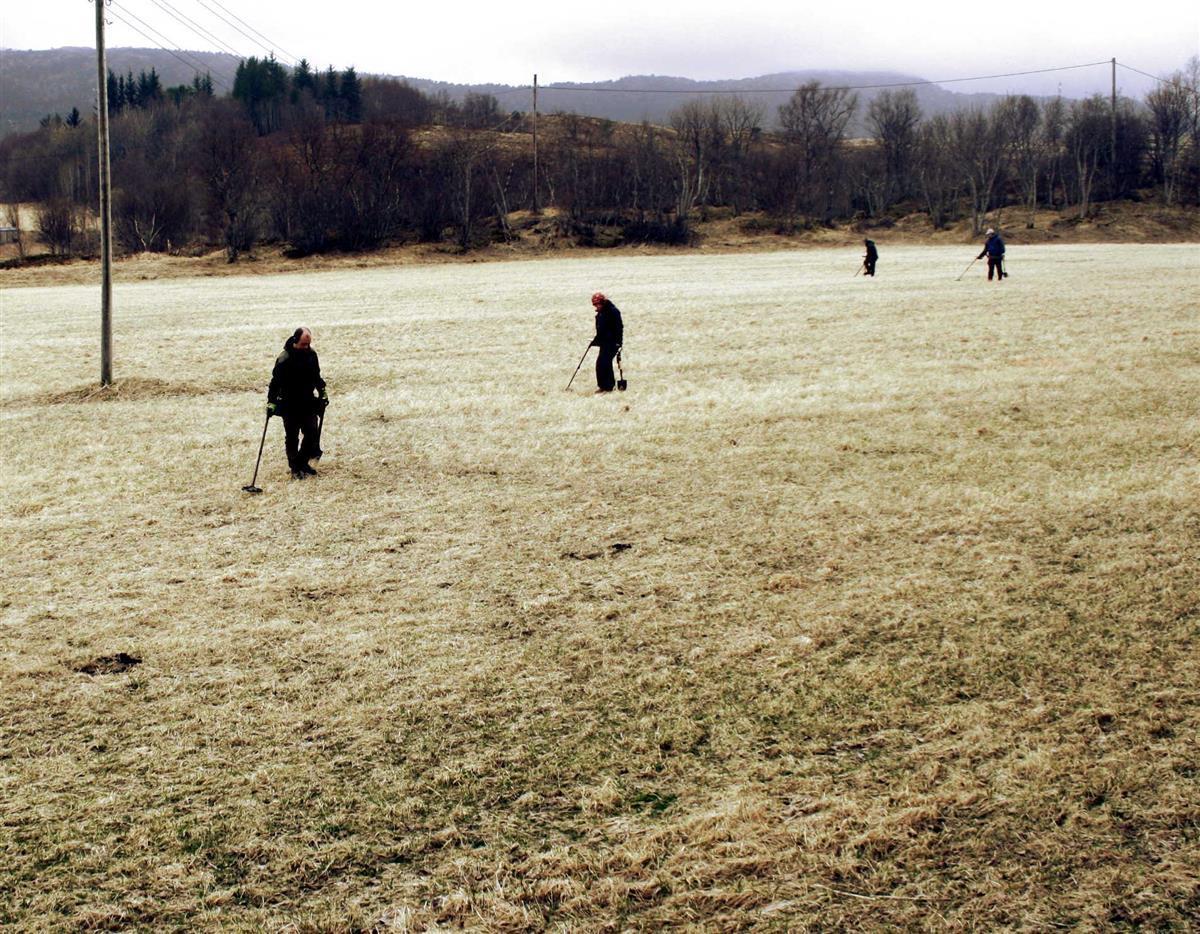
In cultural heritage management, metal detecting is used as a method to detect metal artifacts in archaeological contexts, mainly in connection with registration projects and archaeological excavations.
Automatically protected cultural monuments
Metal detectors should note that objects from the Middle Ages and earlier (before 1537), coins from before 1650 and Sami cultural relics older than 100 years belong to the state. The finds should be reported to the county municipality as the regional cultural heritage authority as soon as possible .
The county council's archaeologists will, depending on the conditions and circumstances of the find, assess the need for an inspection of the site. The county council will arrange for the delivery of the object(s) to the responsible museum.
We emphasize that violating the reporting obligation is a criminal offense and may be followed up with a police report.
We recommend that people who use metal detectors apply for membership in an association or club such as the North Norwegian Metal Detector Club. Visit their website by clicking here
The Norwegian Ministry of Cultural Heritage has drawn up common national guidelines for private metal detecting, which you can find on their guidance pages .
Before you go out
- Prior to the search, the landowner's permission must be obtained. This also applies in cases where the landowner is a public entity, such as the state, county council or municipalities. In this context, we would like to remind you of the Norwegian Information Service Fund, which in many cases is the owner of old parish land.
- Check the cultural heritage database Cultural Heritage Search by clicking here . It is important to note that the database is incomplete and may have inaccurate/incorrect mapping. Some larger sites only have point markings.
- A special cultural heritage category for Northern Norway is the farm mounds/farm grounds. These are almost without exception larger than the geometric surface in Cultural Heritage Search, as they were often visually delimited. We therefore recommend that metal searches do not occur closer than 25 meters from known cultural heritage sites (uncleared and automatically protected).
Context
- Metal detecting should be concentrated on the plough layer in cultivated land. Objects here are out of their original context. Please note that the thickness of the plough layer will vary depending on the topography and soil. Objects lying under the plough layer may be part of an archaeological context, for example a prehistoric grave or settlement. Excavating such objects will be a punishable act of encroachment on automatically protected cultural heritage and will cause great damage. If you come across larger, possibly pre-Reformation objects that extend deeper than the plough layer, the discovery site must be marked and the archaeologist in Nordland County Municipality must be notified.
- The use of metal detectors in open fields should be avoided. Undisturbed archaeological contexts may lie directly beneath the peat. If one digs on the basis of signals from metal detectors in open fields, one may therefore be illegally encroaching on automatically protected cultural heritage.
Upon discovery
If one were to make a discovery that is pre-Reformation, one would in practice be at a cultural heritage site. This means that one should treat the discovery site as one would treat already known sites, i.e. that further searches in the area are carried out 25 meters from the site.
The distance of 25 meters applies even if the cultural heritage's protection status is " unclear ".
Findings processing and documentation:
Objects that you think may be subject to mandatory submission should not be brushed, washed or cleaned as this can remove important information that is not visible. This can be textiles that are attached to objects, remains of wood or even food scraps. Place the object in a bag, preferably with soil from the place of discovery, and mark the bag with coordinates and number so that mix-ups are avoided. When reporting a find, it is also important to agree on how the find will be stored until submission.
Map datum WGS 84 is preferred, zone UTM33N (e.g. E473128/ N7462778). If you do not have a GPS at hand, measure the location to fixed points in the terrain (houses, terrain formations or similar).
Information about the find and the location of the find must then be filled in on a find form prepared by the Norwegian Ministry of Cultural Heritage. You can find the form by clicking here (PDF, 241 kB)
The following points are important in order to be able to say something about context:
- description of subsoil
- description of the site
- possible observations of heat-affected rock, coal and the like
All finds must be handed over to Nordland County Council. The county council is the responsible authority and registers finds in discovery databases. The finds are then delivered to the NTNU Science Museum or the Arctic University Museum of Norway for conservation and safe storage.
Finder's salary
If you find an object that is a loose cultural monument, you may be able to receive a finder's fee. The Cultural Heritage Act contains provisions on determining finder's fees for loose cultural monuments, this also applies to ship finds older than 100 years. Finder's fees are determined at the discretion of the Norwegian Ministry of Cultural Heritage and are divided equally between the finder and the landowner.
The Norwegian Agency for Cultural Heritage's guidelines for determining finder's compensation can be found by clicking here.